Real-World Duct UI: Granular State Management in a Word Game
Explore how Duct UI powers a multi-board word puzzle with granular observable state management, component refs, and SSG-compatible architecture. A practical example of building interactive games with surgical DOM updates and explicit memory management.
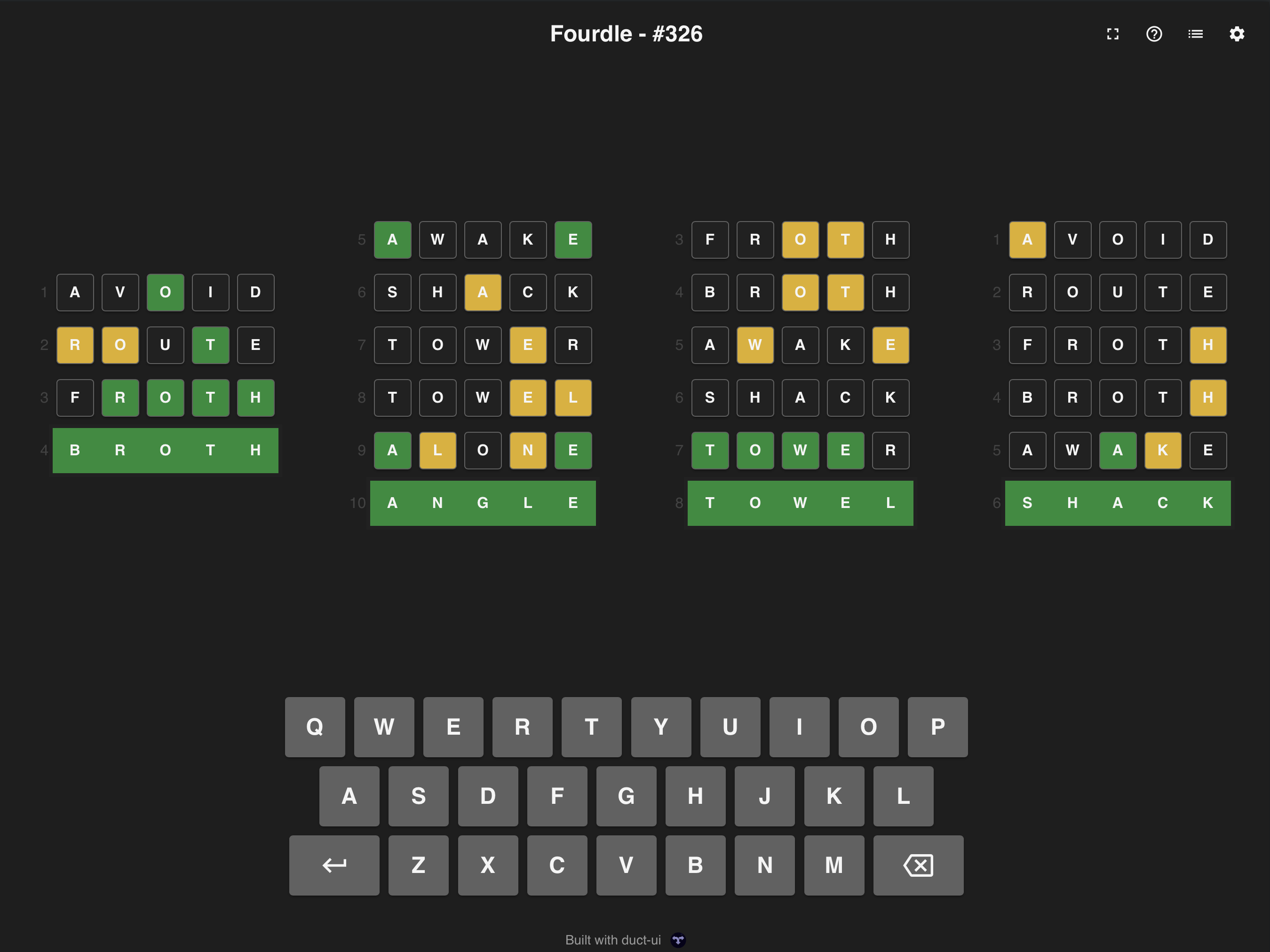
Live Example: Fourdle 🔗
Website: https://fourdle.puthir.org/ Source Code: https://github.com/puthirali/fourdle
This word puzzle game showcases Duct UI’s power for building stateful applications with fine-grained reactivity. The game manages multiple simultaneous Wordle-style boards with slot-level state subscriptions, demonstrating advanced patterns for performance optimization and memory management.
Key Patterns Demonstrated 🔗
1. Granular Observable State Management 🔗
The core introduction is a state service with surgical precision updates—components subscribe to individual slots, not entire boards. This is simply a template to show how such a service can be constructed. A robust structure can be built upon this specific model to make event based state management centralized, de-centralized or federated.
Implementation Highlights:
- Namespace-based event subscriptions:
slot:${boardIndex}:${entryIndex}:${slotIndex} - Change detection computes deltas between old and new state
- Only changed slots/entries/boards emit events
- Pure function separation for state computations
See it live: Visit fourdle.puthir.org and notice how only the slots you type into update, not the entire board.
Technical approach: The state service computes granular changes and emits targeted events, allowing components to subscribe only to their specific data.
2. Render/Bind Lifecycle Separation 🔗
The application strictly separates pure rendering from side effects using Duct’s render/bind pattern.
Architecture Features:
- Pure Render Functions: Return JSX with no side effects (SSG-compatible)
- Bind Lifecycle: All subscriptions, DOM manipulation, and cleanup
- Explicit Cleanup:
release()functions prevent memory leaks - SSG Constraints: localStorage access only in
bind(), never inrender()
See it in action: The game pre-renders statically for instant loading, then hydrates with client-side state.
Source code reference: Every component in src/components/ follows this pattern consistently.
3. Component Refs for Parent-Child Communication 🔗
The app demonstrates type-safe parent-child communication using Duct’s createRef pattern.
Communication Patterns:
- Ref Creation:
const helpModalRef = createRef<HelpModalLogic>() - Logic Exposure: Components expose methods via
BindReturn<ComponentLogic> - Parent Control: Parents call
helpModalRef.current?.open() - Type Safety: Full TypeScript support for exposed APIs
// From App.tsx - controlling modals via refs
const helpModalRef = createRef<HelpModalLogic>()

<Header
  on:help-click={() => {
    const modalLogic = helpModalRef.current
    if (modalLogic) {
      modalLogic.open()
    }
  }}
/>
<HelpModal isOpen={false} ref={helpModalRef} />
4. Manual DOM Updates with Event Re-attachment 🔗
The interface demonstrates the innerHTML re-rendering pattern with manual event listener management.
Component Integration:
- Dynamic Content: Using JSX helper functions for re-renderable content
- Event Re-attachment: Listeners manually re-added after innerHTML updates
- State in Bind: Component state stored in bind closure, not React state
- Controlled Updates: Explicit
renderTabs()calls, no automatic re-renders
Source reference: SummaryModal.tsx shows complex dynamic tab rendering with event re-attachment.
5. Explicit Memory Management 🔗
The application provides clear examples of subscription cleanup and memory leak prevention.
Memory Management Features:
- Symmetric
on()/off()calls for all subscriptions - Event listener cleanup in
release() - Timeout cleanup with stored timeout IDs
Check how every component’s bind() function returns a release() that cleans up all subscriptions.
Architecture Deep Dive 🔗
Granular State Change Detection 🔗
// From state-service.ts - computing granular changes
function computeChanges(oldState: State, newState: State): GranularChange[] {
  const changes: GranularChange[] = []

  oldState.boards.forEach((oldBoard, boardIndex) => {
    const newBoard = newState.boards[boardIndex]

    // Compare each entry
    oldBoard.board.entries.forEach((oldEntry, entryIndex) => {
      const newEntry = newBoard.board.entries[entryIndex]

      // Compare each slot
      for (let slotIndex = 0; slotIndex < 5; slotIndex++) {
        const oldChar = oldEntry.chars[slotIndex]
        const newChar = newEntry.chars[slotIndex]

        if (oldChar?.char !== newChar?.char || oldChar?.mode !== newChar?.mode) {
          changes.push({
            type: 'slot',
            boardIndex,
            entryIndex,
            slotIndex,
            data: { char: newChar, isCommitted: newEntry.isCommitted }
          })
        }
      }
    })
  })

  return changes
}
Component Subscription Pattern 🔗
// From Slot.tsx - subscribing to slot-specific changes
function bind(el: HTMLElement, _eventEmitter: any, props: SlotProps): BindReturn<SlotLogic> {
  const { boardIndex, entryIndex, slotIndex } = props
  const stateService = getStateService()

  // Subscribe to granular slot-specific event
  const eventName = `slot:${boardIndex}:${entryIndex}:${slotIndex}` as any
  const handleSlotChange = (slotData: any) => {
    const keyCap = slotData.char || emptyChar
    const text = keyCap.char.trim() === "" ? "\u00A0" : keyCap.char.toUpperCase()

    // Direct DOM updates
    if (frontFace) frontFace.textContent = text
    if (backFace) backFace.textContent = text

    // Update classes
    el.classList.toggle('flipped', slotData.isCommitted)
    if (backFace) {
      backFace.className = `slot-face slot-back mode-${keyCap.mode}`
    }
  }

  stateService.on(eventName, handleSlotChange)

  return {
    release: () => {
      stateService.off(eventName, handleSlotChange)
    }
  }
}
Technical Stack 🔗
- Framework: Duct UI (SSG with client-side hydration)
- State Management: Observable pattern with lib0/observable
- Build Tool: Vite + @duct-ui/cli
- Styling: Tailwind CSS 4 + DaisyUI
- Animations: CSS transforms + @formkit/auto-animate
- Type Safety: TypeScript with strict mode
- Package Manager: pnpm
- Deployment: Static site generation
Running Locally 🔗
To explore this example locally:
# Clone the repository
git clone https://github.com/puthirali/fourdle.git
cd fourdle

# Install dependencies
pnpm install

# Start development server
pnpm dev

# Build for production
pnpm build
Key Takeaways 🔗
This real-world example demonstrates:
- Granular Subscriptions: Slot-level event subscriptions for surgical DOM updates
- Render/Bind Separation: SSG-compatible architecture with clear lifecycle boundaries
- Component Refs: Type-safe parent-child communication without prop drilling
- Manual Memory Management: Explicit cleanup patterns for subscription lifecycle
- Observable Singleton: Centralized state service with granular event emission
- Dynamic Re-rendering: innerHTML pattern with event listener re-attachment
Code Examples to Study 🔗
Granular State Service 🔗
Examine state-service.ts to understand change detection, observable events, and the singleton pattern (495 lines of state management gold).
Render/Bind Pattern 🔗
Study Slot.tsx for the canonical example: pure render() function with all side effects in bind().
Component Refs 🔗
See App.tsx for how parent components control modals using createRef.
Dynamic Content Re-rendering 🔗
Observe SummaryModal.tsx for the innerHTML pattern with manual event re-attachment.
Memory Management 🔗
Every component demonstrates proper cleanup—check the release() functions to see subscription cleanup patterns.
Advanced Patterns Highlighted 🔗
1. Event Subscription Naming Convention 🔗
The app uses a consistent string-based event naming pattern:
// Slot-level: slot:boardIndex:entryIndex:slotIndex
stateService.on(`slot:${boardIndex}:${entryIndex}:${slotIndex}`, handler)

// Entry-level: entry:boardIndex:entryIndex
stateService.on(`entry:${boardIndex}:${entryIndex}`, handler)

// Board-level: board:boardIndex
stateService.on(`board:${boardIndex}`, handler)

// Keycap-level: keycap:character
stateService.on(`keycap:${char}`, handler)
This convention allows components to subscribe to exactly what they need.
2. SSG-Compatible State Access 🔗
// ❌ DON'T: This breaks SSG build
function render(props) {
  const savedMode = localStorage.getItem('game-mode')
  return <div>{savedMode}</div>
}

// ✅ DO: Access browser APIs only in bind
function bind(el) {
  const savedMode = localStorage.getItem('game-mode')
  // Use savedMode for client-side initialization
  return { release: () => {} }
}
3. Component Logic Exposure 🔗
// From HelpModal.tsx - exposing imperative API
export interface HelpModalLogic {
  open: () => void
  close: () => void
}

function bind(_el: HTMLElement): BindReturn<HelpModalLogic> {
  return {
    open: () => {
      const modalLogic = innerModalRef.current
      if (modalLogic?.show) {
        modalLogic.show()
      }
    },
    close: () => {
      const modalLogic = innerModalRef.current
      if (modalLogic?.hide) {
        modalLogic.hide()
      }
    },
    release: () => {}
  }
}
A High-Performance Game 🔗
This project showcases Duct UI’s capability for building interactive applications where performance matters. The granular subscription pattern means typing a letter updates only one slot, not 20+ components.
The combination of observable state, render/bind separation, and explicit memory management creates a responsive user experience that demonstrates production-ready architectural patterns.
Visit fourdle.puthir.org to play the game, and explore the source code to understand the granular state management implementation.
Share Your Duct UI Project! 🔗
Building games or interactive applications with Duct UI? We’d love to see your work!
Join the conversation: Share your projects, ask questions, and connect with the Duct UI community in our GitHub Discussions.
Whether you’re building games, data applications, or state-driven interfaces, your examples help demonstrate Duct UI’s architectural capabilities and inspire others.
Start a discussion about your Duct UI project at github.com/navilan/duct-ui/discussions